What you do in Atomic Assembly
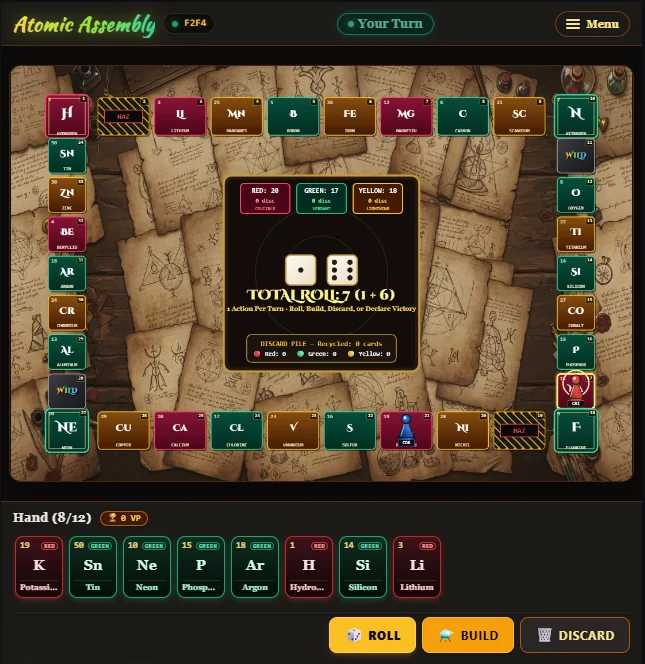
You are an apprentice alchemist. Each turn you roll two dice and walk clockwise around a 34-space track, drawing element cards from the spaces you land on. Hydrogen, tin, neon, iron, sulfur: the cards are the elements, and you spend them to assemble constructs from a shared list of twelve blueprints.
Nine of the blueprints are standard constructs worth one to nine victory points each, and you can build them as often as you like. Three are Required Constructs. Build all three and you hold all three Proof Tokens, which unlocks the Declare Victory action. Declaring does not end the game on the spot: every other player gets one final turn to catch up.
It is a game of collecting, timing and a little nerve. You can hold only twelve cards, you get one action per turn, and the Hazard spaces can take up to twenty points off your score.
One action per turn
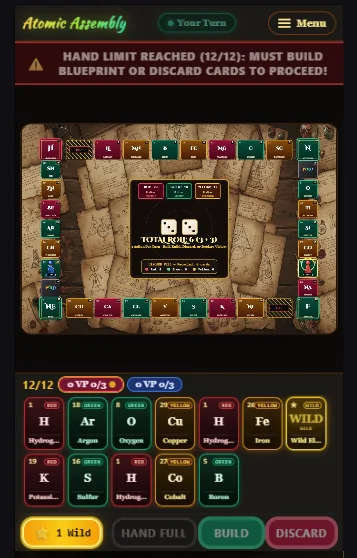
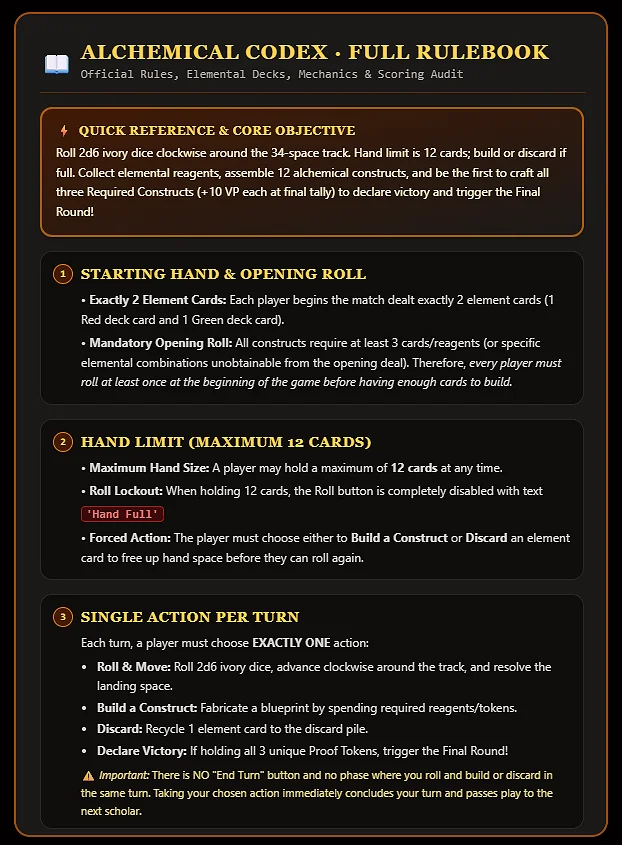
On your turn you choose exactly one of these. There is no end-turn button, and you cannot roll and build in the same turn.
- Roll and move. Roll 2d6, move clockwise, and resolve the space you land on.
- Build a construct. Spend the cards or tokens a blueprint asks for. Building ends your turn.
- Discard. Recycle one element card to the discard pile.
- Declare victory. Available once you hold all three Proof Tokens.
Getting started
Everyone is dealt two element cards, one from the Red deck and one from the Green deck. Every blueprint needs at least three cards, so every player has to roll at least once before they can build anything.
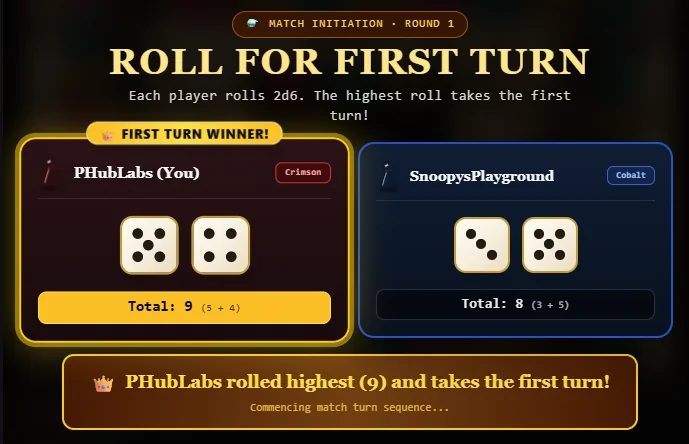
To decide who goes first, each player rolls 2d6 and the highest total takes the first turn.
The hand limit is twelve cards. At twelve the Roll button locks and shows "Hand Full", and you must build or discard before you can roll again.
The track and the three decks
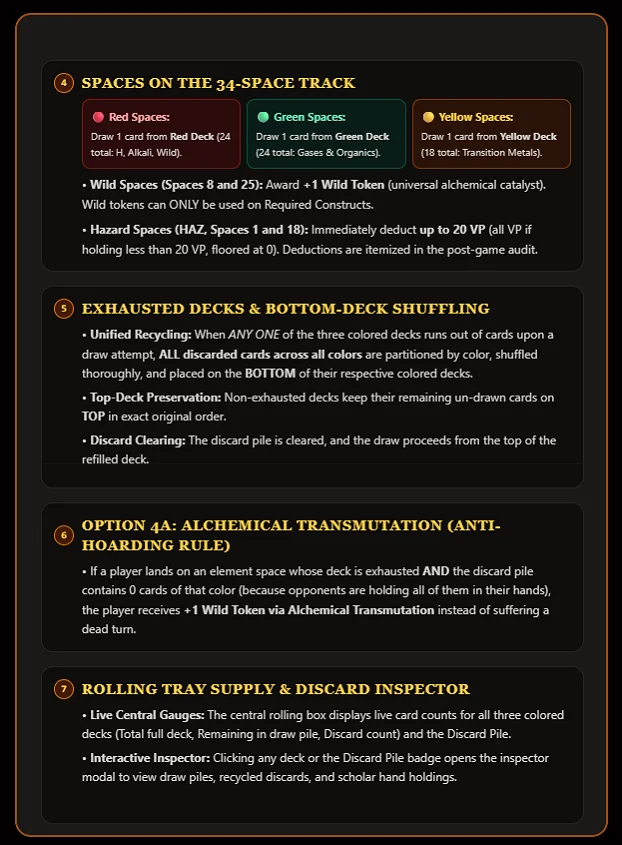
Element spaces are colored to match the three card decks. Landing on one draws a card from that deck.
Special spaces
- Wild spaces (8 and 25) give you a Wild Token, a universal catalyst that can stand in for a missing card on Required Constructs only.
- Hazard spaces (1 and 18) cost you up to 20 victory points right away. If you have fewer than 20, you lose them all but never drop below zero.
Wild cards and Wild Tokens
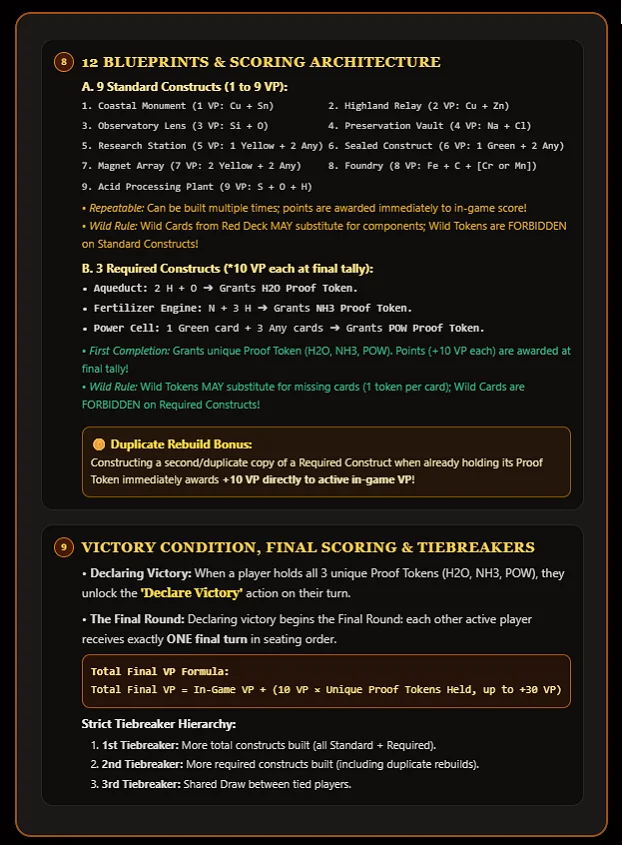
Wild cards from the Red deck can substitute for components on standard constructs. Wild Tokens can substitute only on Required Constructs, one token per missing card. Each kind is forbidden where the other is allowed.
When a deck runs out
If any deck is empty when someone tries to draw, all the discarded cards are sorted by color, shuffled, and placed on the bottom of their decks. The cards still waiting in each deck stay on top in their original order.
The anti-hoarding rule
If you land on an element space whose deck is empty and the discard pile holds none of that color, because your opponents are holding all of them, you receive a Wild Token through Alchemical Transmutation instead of losing your turn.
Blueprints and scoring
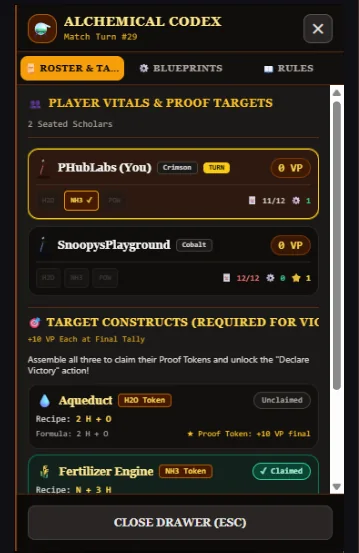
The three Required Constructs
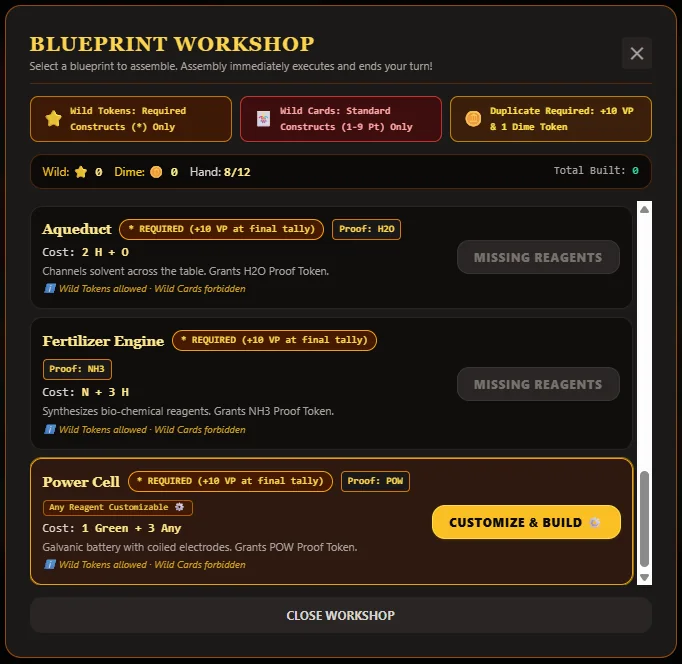
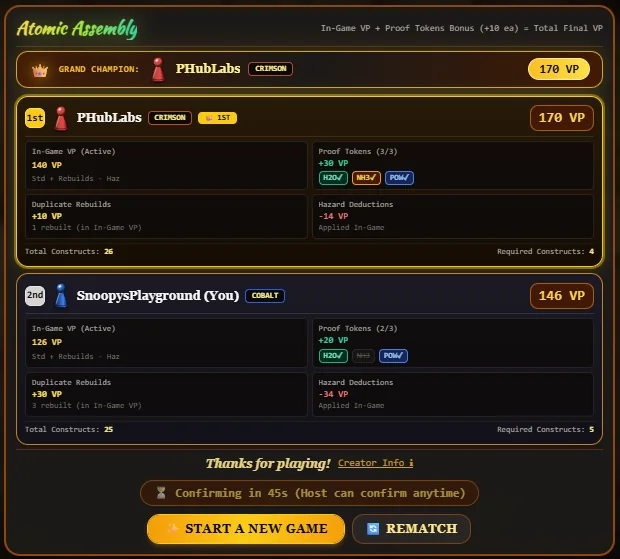
Each one you build for the first time earns its Proof Token, and each Proof Token is worth 10 points in the final tally. Build a second copy of a Required Construct you already hold the token for, and you score 10 points straight away.
- H2O
- NH3
- POW
| Construct | Cost | Proof Token |
|---|---|---|
| Aqueduct | 2 H + O | H2O |
| Fertilizer Engine | N + 3 H | NH3 |
| Power Cell | 1 Green card + 3 any cards | POW |
The nine standard constructs
Points are added to your score the moment you build. They can be built repeatedly.
| # | Construct | Points | Cost |
|---|---|---|---|
| 1 | Coastal Monument | 1 | Cu + Sn |
| 2 | Highland Relay | 2 | Cu + Zn |
| 3 | Observatory Lens | 3 | Si + O |
| 4 | Preservation Vault | 4 | Na + Cl |
| 5 | Research Station | 5 | 1 Yellow + 2 any |
| 6 | Sealed Construct | 6 | 1 Green + 2 any |
| 7 | Magnet Array | 7 | 2 Yellow + 2 any |
| 8 | Foundry | 8 | Fe + C + (Cr or Mn) |
| 9 | Acid Processing Plant | 9 | S + O + H |
Ending the game
When you hold all three Proof Tokens, you can declare victory on your turn. That starts the final round: every other player takes exactly one more turn, in seating order. Then scores are totalled.
If scores tie, the winner is the player who built more constructs in total. If that is level too, the player with more Required Constructs wins, counting duplicates. If it is still level, the game is a shared draw.
Screenshots
The rulebook is built in
The full rulebook opens from inside the game, so nobody has to leave the table to check a rule.
Start an online game
- Open the game and press Play.
- Press Invite and send the link to one to three friends.
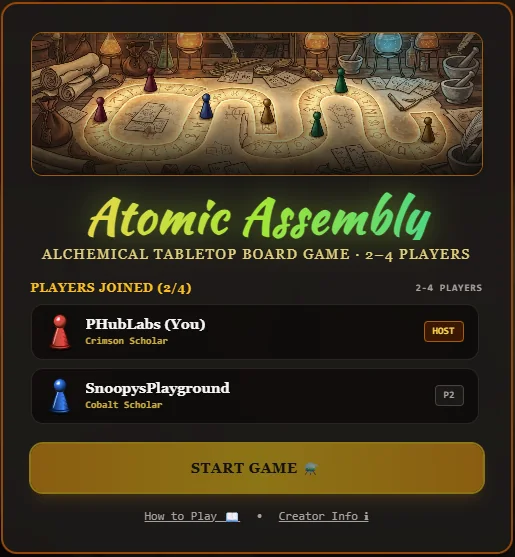
- Each friend opens the link and accepts. Their name and pawn color appear in the lobby.
- The host presses Start Game, and everyone rolls for first turn.
Questions
How long does a game take?
Plan on two to two and a half hours.
Can I play on a phone or tablet?
Yes. The game has a layout for phones and tablets as well as desktop browsers.
How many people can play?
Two to four players. Everyone joins from their own device.
Is there a physical edition?
A physical tabletop edition is in development. The online game follows the same rules.